Hedging export receivables after the RBI's October 2026 forex rules
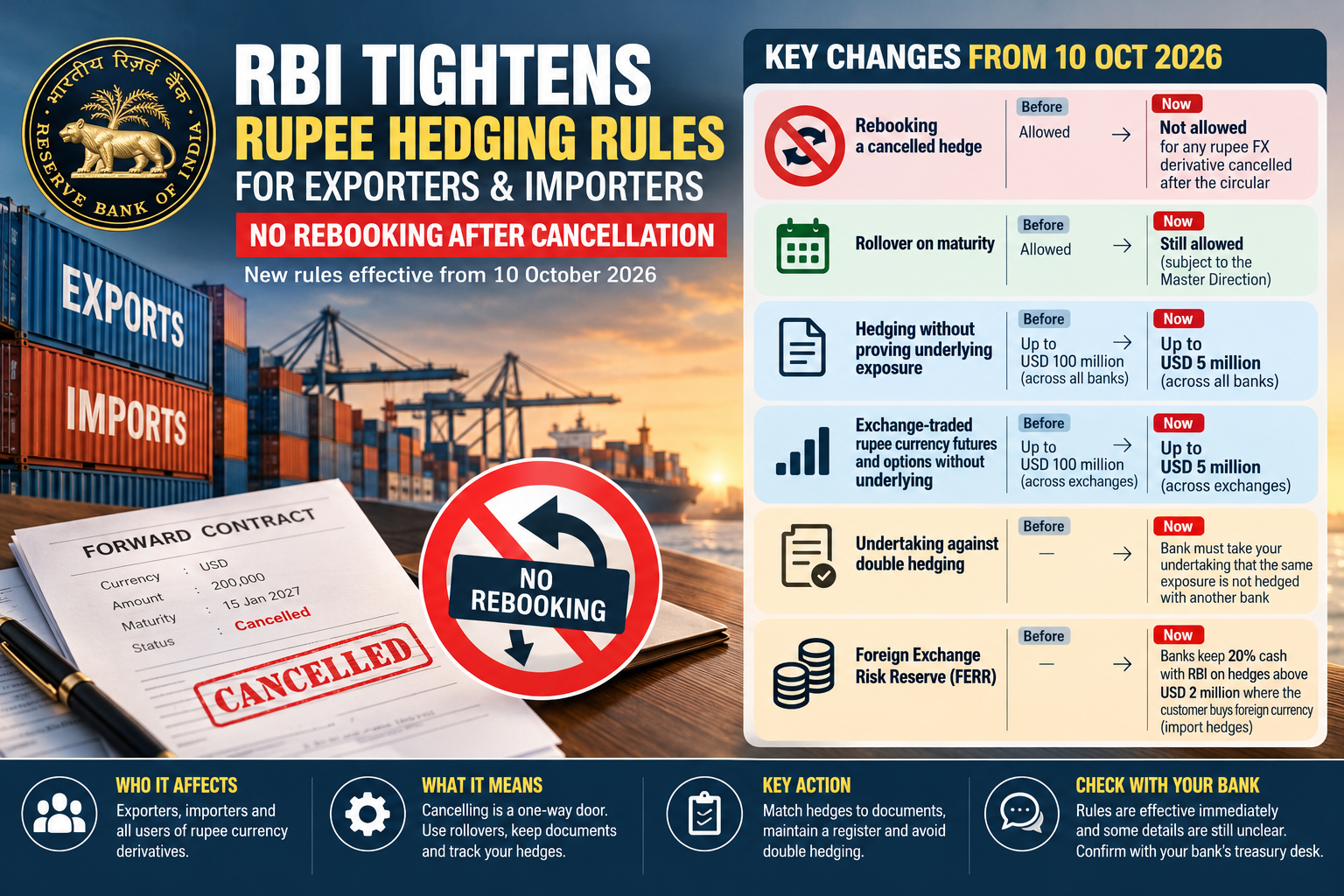
On 10 October 2026 the Reserve Bank of India changed the rules on how exporters and importers can use forward contracts and other rupee currency hedges. The changes took effect the same day. If you book forwards with your bank to protect export receivables, the biggest change is simple: once you cancel a hedge, you can no longer rebook it. This guide explains what changed, who it affects and how to adjust your hedging routine.
What the RBI changed
The RBI issued two circulars on 10 October 2026: A.P. (DIR Series) Circular No. 25 and Circular No. 26. Both amend the Master Direction on Risk Management and Inter-Bank Dealings (5 July 2016). The RBI's press release says they were issued "to ensure orderly functioning of the foreign exchange market".
| Rule | Before 10 Oct 2026 | From 10 Oct 2026 |
|---|---|---|
| Rebooking a cancelled hedge | Allowed, subject to the Master Direction | Not allowed for any rupee FX derivative cancelled with any bank after the circular |
| Rollover on maturity | Allowed | Still allowed, subject to the Master Direction |
| Hedging contracted exposure without proving the underlying exposure | Up to USD 100 million across all banks | Up to USD 5 million across all banks |
| Exchange-traded rupee currency futures/options without underlying | Up to USD 100 million across exchanges | Up to USD 5 million across exchanges |
| Undertaking against double hedging | (new requirement) | Bank must take your undertaking that the same exposure is not hedged with another bank |
| Foreign Exchange Risk Reserve (FERR) | (new requirement) | Banks keep 20% cash with RBI on hedges above USD 2 million where the customer buys foreign currency |
Who it applies to
- Exporters who hedge receivables with forwards, options or swaps against the rupee: the rebooking ban, the USD 5 million cap and the new undertaking all apply. Circular No. 25 refers to all "users" and does not distinguish exporters from importers.
- Importers, and exporters who import inputs: Circular No. 26 makes banks hold a 20% Foreign Exchange Risk Reserve on rupee FX derivatives with a notional value above USD 2 million where the customer is purchasing foreign currency to hedge current-account transactions. Splitting a deal across banks to stay under USD 2 million is treated as a violation.
- Exporters selling foreign currency do not appear to be covered by the FERR, because it applies only where the customer buys foreign currency.
The circulars do not mention a size threshold for the rebooking ban, so it applies to small hedges as well as large ones.
What this means in practice
1. Cancelling is now a one-way door
Many exporters used to cancel a forward when a shipment slipped or a buyer changed the payment date, then book a fresh one later. From 10 October 2026, a contract cancelled with any bank cannot be rebooked. If you cancel, you settle the gain or loss and that hedge is gone.
2. Rollover is the main tool for delays
The RBI has kept rollovers on maturity. If your buyer pays late, ask your bank to roll the contract over to the new expected date instead of cancelling it. Rollovers remain subject to the Master Direction and your bank's terms, so confirm the cost and the documents needed.
3. Keep documents ready for every hedge
Hedges booked without showing an underlying exposure are now capped at USD 5 million across all your banks. Above that, your bank must see the underlying contract. Banks must keep supporting documents for at least two years.
4. One exposure, one hedge
Your bank will ask you to confirm that the same receivable is not hedged elsewhere. If you split a large order between two banks, the undertaking must list the amounts already booked with the other bank. The undertaking can be part of the deal confirmation.
Step by step: a hedging routine under the new rules
- Match each hedge to a document. Link every forward to a sales contract, purchase order or invoice, with amount, currency and expected payment date.
- Keep a hedge register. Record bank, contract number, amount, maturity and the invoice it covers. This makes the double-hedging undertaking easy and tracks your undocumented total against USD 5 million.
- Pick maturities carefully. Exportsmitra suggests setting the forward date a little after the realistic payment date (allowing for transit and bank processing), since you can no longer cancel and rebook.
- Consider part-hedging uncertain orders. Exportsmitra suggests hedging only the portion you are confident about when a shipment date or quantity is uncertain, and adding cover once it firms up.
- Before cancelling, ask about rollover. Call your bank's treasury desk first. Cancel only when the underlying sale has really fallen through.
- If you also import, ask your bank whether the 20% reserve on import hedges above USD 2 million will change its pricing.
Worked example
A Tiruppur garment exporter books a 90-day forward to sell USD 200,000, covering an order due for payment on 15 January. In December the buyer asks to delay shipment by six weeks.
- Old habit: cancel the forward now, then book a new one once the new date is confirmed.
- Under the new rules: if the exporter cancels, that contract cannot be rebooked. The better route is to keep the contract and ask the bank to roll it over at maturity to the new payment date, with the revised order or buyer's email as support.
- If the order is cancelled outright, the exposure no longer exists and cancelling the forward is the right step. Whether a fresh hedge for a different, new order counts as a "rebooking" is not spelled out in the circular: confirm with your bank.
Common mistakes to avoid
- Cancelling a forward for a delayed order without first asking about rollover.
- Hedging the same invoice with two banks, or forgetting to list amounts booked elsewhere in the undertaking.
- Losing track of undocumented hedges across banks and exchanges against the USD 5 million cap.
- Assuming the 20% reserve does not matter because you export: if you hedge imported inputs above USD 2 million, it may affect you.
- Relying on old bank paperwork: ask your relationship manager for the updated deal confirmation and undertaking format.
What is still unclear
The circulars apply "with immediate effect" and do not say whether these are temporary. They also do not spell out how the rebooking ban treats a new hedge for a different exposure. Check with your bank's treasury desk, and watch for RBI FAQs or clarifications.
For the basics of forwards, options and PCFC, see our guide Managing currency risk: forwards, options and PCFC.
Sources
- RBI A.P. (DIR Series) Circular No. 25, 10 Oct 2026 – Risk Management and Inter-Bank Dealings
- RBI A.P. (DIR Series) Circular No. 26, 10 Oct 2026 – Foreign Exchange Risk Reserve
- RBI press release: Regulatory Measures for the Foreign Exchange Market, 10 Oct 2026
Last checked: 12 October 2026.
Drafted with AI help from public sources.
Nothing here yet.
Sign in to leave a comment.